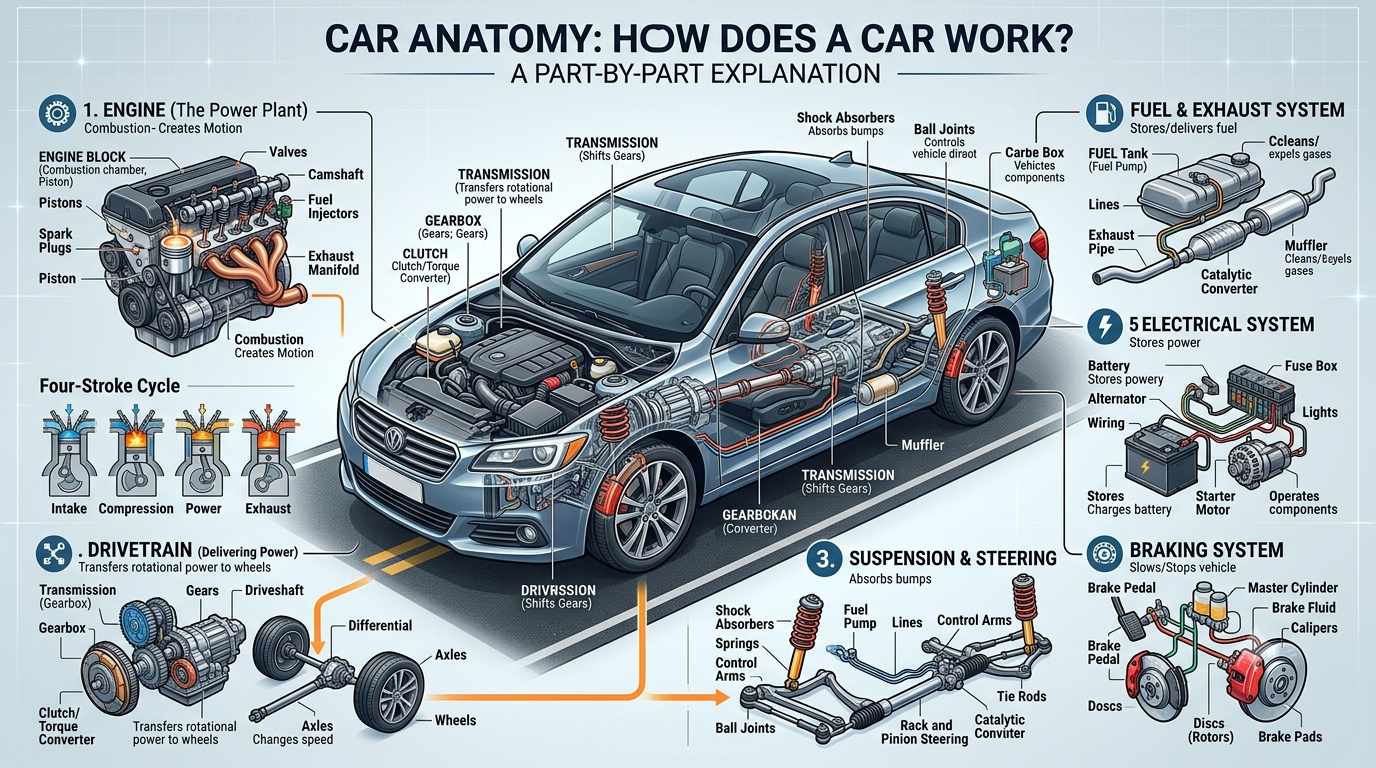
An automobile is much more than an engine, 4 wheels and a steering wheel. It is a carefully connected machine wherein masses of components work collectively to show energy into movement, manipulate velocity, deal with corners and preserve passengers safe. The main structures consist of the energy unit, transmission, chassis, suspension, steering, brakes and electric components.
In this car anatomy guide, we will have a look at every crucial element one by one and understand its real task in easy language. From what takes location within the engine when you press the accelerator to how the gearbox sends energy to the wheels, each level has a position. We can also cover the suspension, guidance, braking, tyres, electric gadgets, and other crucial additions, supplying you with a clear picture of the manner a vehicle works from the interior out.
1. Engine: The Main Power Source
The engine is frequently known as the heart of a conventional car, as it produces the electricity needed to power the automobile. In a petroleum or diesel engine, fuel and air enter the cylinders, wherein combustion creates stress. That stress pushes the pistons up and down. The pistons are linked to the crankshaft, which converts this up-and-down movement into rotational motion. This rotating electricity is then dispatched via the transmission and finally reaches the wheels.
2. Air Intake System
An engine requires clean air to effectively turbo-burn fuel. This unit filters air meant for the engine from outside.
The air filter prevents dust and other particles from entering. A dirty filter is an air flow restriction and will cause issues with your engine like performance issues or driving up gas mileage.
3. Fuel System
The fuel system stores and delivers fuel to the engine. Its main components include the fuel tank, fuel pump, fuel lines, injectors and related controls.
Modern cars use electronic fuel injection to deliver a carefully measured amount of fuel. The engine control unit adjusts fuel delivery according to driving conditions, engine speed and other sensor readings.
4. Pistons and Cylinders
The actual cylinders are the chambers where combustion occurs. The piston moves up and down repeatedly in each cylinder.
In a four-stroke petrol engine, the piston passes through four stages: intake, compression, and power and exhaust. The process repeats itself quickly as the motor is running, creating the mechanical energy to get your car moving.
5. Crankshaft
The crankshaft converts the pistons’ linear movement into rotational movement. It sits inside the lower segment of the engine and is connected to the pistons through connecting rods. Once the crankshaft begins rotating, its movement may be transferred to the transmission. That is one of the most critical steps in turning combustion into usable riding energy.
6. Cooling System
Engines produce a great deal of heat while running. The excessive temperature is prevented by the cooling system.
Coolant flows through passages around the engine, collecting heat to be carried off to the radiator. This heat gets released into the surrounding air by the radiator. The water pump, thermostat, radiator and cooling fan are all parts of a car that help keep the engine at its proper temperature.
7. Lubrication System
In an engine, moving parts rub up against each other all the time and require some form of lubrication. Oil is also an impressive friction star, managing heat and routing tiny contaminants away from critical surfaces.
The oil pump provides circulation of the oil in the engine. After which, the oil filter eliminates any undesired particles before the oil continues to circulate throughout the lubrication system.
8. Transmission or Gearbox
The engine produces electricity within a certain operating variety, while the wheels need unique quantities of torque and speed depending on the scenario. The transmission manages this distinction. Manual gearboxes use gears decided on with the aid of the driving force, while automatic transmissions alternate ratios with very little direct driving force input. The transmission sends appropriate electricity towards the driven wheels.
9. Clutch
However in a manual car, the clutch links and breaks the contact between the engine and the gearbox. Hit the clutch pedal, and the connection breaks momentarily as you shift through the gears.
The transmission is connected to the engine through the use of a clutch, and as soon as a gear is selected, releasing the clutch progressively links both sides together. Based on the design of the transmission, automatic cars deploy several different mechanisms including torque converters and clutch-based systems.
10. Driveshaft and Differential
The transmission has to transfer power to the wheels. This can be through driveshafts, axles and more depending on the layout of the vehicle.
The differential is all the more important, as the left and right wheels have to turn at different speeds when the auto travels round a corner. It allows this disparity in wheel speed when distributing torque.
11. Suspension System
Wheels attach to the vehicle body through suspension, which allows for limited vertical movement (due to pavement bumps or irregularities).
Springs hold the weight of the vehicle and shock absorbers or dampers are designed to control how much it bounces around. An exception is the suspension, where a balance between ride comfort and handling must be struck.
12. Steering System
The humanity of the steering system enables the vehicle’s operator to determine its direction. The idea is simple: You turn your steering wheel, and that motion travels through the steering mechanism to your front (and in some cases, rear) wheels.
In modern times, electric power steering assistance (aided by an electric motor) is standard on many cars. This makes it less demanding to transform the steering wheel.
13. Braking System
The braking system works to slow down or stop the car and would convert the kinetic energy of the vehicle into heat through friction.
By pressing the brake pedal, you produce hydraulic force transmitted to the brakes. Disc brakes mechanically work with a caliper and brake pads that squeeze down onto a rotating disc; comparatively, drum brakes use brake shoes inside of a drum.
14. ABS and Electronic Brake Controls
ABS, or Anti-lock Braking device, prevents the wheels from locking up during emergency braking. Sensors check the velocity of wheels and based on that, the system adjusts brake pressure when needed.
Today’s cars use a variety of electronic systems (such as electronic brake-force distribution and brake assist) to help drivers stop effectively in various driving situations.
15. Wheels and Tyres
Tyres are the only parts that usually actually contact the ground. They give you the grip for acceleration, braking and steering.
Wheels provide support for tires and are attached to the vehicle via hubs and suspension parts. The safe and correct tyre pressure is important because it affects handling, braking, comfort and efficiency.
16. Battery and Electrical System
In a typical gas-powered vehicle, the battery provides electrical power while the engine is off and additionally aids in engine start. As soon as the engine is walking, the alternator generates energy and facilitates recharging the battery. The electric device additionally components strength to lights, units, infotainment, sensors, protection systems, wipers and more.
17. Alternator
When the engine is running, the alternator produces electricity. It provides power to the vehicle systems, as well as recharging the battery.
Should the charging system develop a fault, the battery will eventually go flat, resulting in loss of some electrical functions and also potentially preventing engine starting.
18. Exhaust System
Once combustion has occurred, exhaust gases need to be channelled out of the engine away from the passengers.
The exhaust contains everything from the exhaust manifold to the catalytic converter, pipes, muffler, and depending on your vehicle, particulate filters and various other emission-control equipment. Those components help reduce emissions and control exhaust volume.
19. ECU and Sensors
A major part of modern cars is the fact that they are electronically controlled. Different sensors feed the Engine Control Unit (ECU) with information that is then used to regulate functions like fuel injection, ignition and emissions.
They could be sensors that can track engine temps, airflow, throttle position, oxygen levels, and crankshaft location among other things. Such a network enables the car to be altered by changing driving situations rapidly.
20. Car Body and Chassis
The body provides the vehicle’s outer structure, passenger space and mounting points for many components. The chassis or structural platform supports major mechanical systems and helps manage loads during driving.
Modern vehicles are designed with specific structural zones to provide strength while also helping manage crash energy.
21. How All Car Parts Work Together
When you press the accelerator in a petroleum or diesel automobile, the engine management system responds through controlling the quantity of air and gas entering the engine. Combustion moves the pistons, the crankshaft rotates, and the transmission receives that strength. The gearbox selects the best ratio, while the differential and axles transfer torque to the driven wheels. At the same time, the suspension continues to keep the tyres connected to the road, and the guidance system controls the route. When you press the brake pedal, the braking system reduces wheel speed. Digital systems can screen wheel behavior, while the suspension and tyres help maintain balance. All of those movements show up together, often within fractions of a second.
Final Thoughts
A car works because many individual systems perform special jobs; however, they remain carefully related. The engine or electric-powered motor creates driving pressure, the transmission manages it, the drivetrain sends it to the wheels, and the guidance, suspension and brakes allow the driver to control the automobile. When you comprehend these primary parts, vehicle preservation and troubleshooting become lots easier. Even a easy dashboard caution or an unusual sound starts to make extra feel when you recognize which system is accountable for every function.